sparrowflight · cli
Working —
v0.20.0 · validated against five Flight SQL servers · open source on
GitHub
The terminal is the oldest client.
Time it spoke Arrow.
Time it spoke Arrow.
Every Flight server demo today starts with "first, write a Python script."
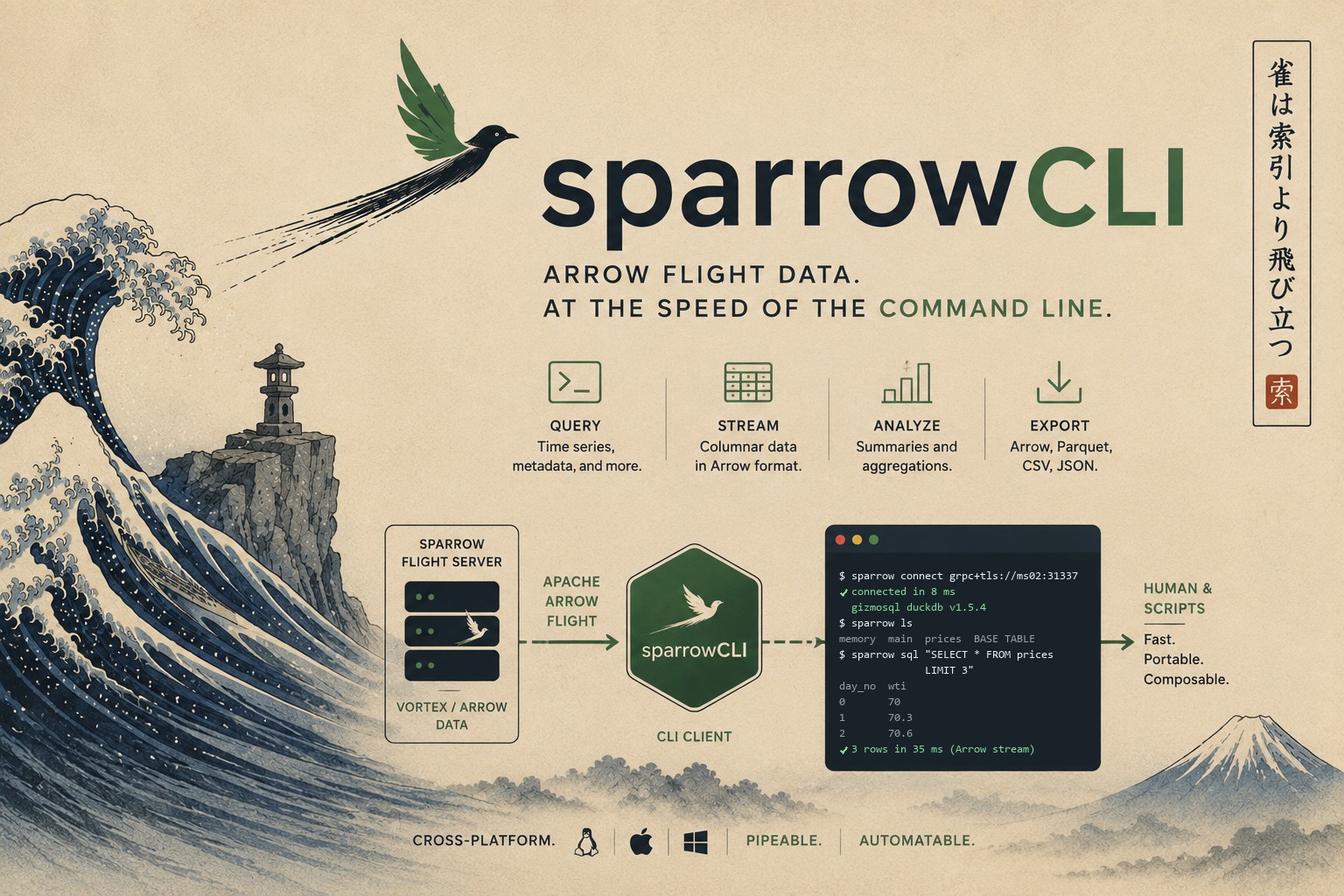
sparrowCLI is one binary: connect to any Arrow Flight SQL
server, browse the catalog, run SQL, and pipe columnar data onward — to a
file, a chart, or the next process.
a real session — this server, today
$ sparrow connect grpc+tls://flight.sparrowflight.io:443 --basic demo:demo
✓ connected in 535 ms — EnergyScope 1.0
$ sparrow info series_data
table: series_data (TABLE)
columns: series_id utf8 · period utf8 · value float64
rows: 136,052,269
$ sparrow sql "SELECT series_id, COUNT(*) AS n FROM series_data GROUP BY 1 ORDER BY n DESC LIMIT 3" -o md
| series_id | n | …
$ sparrow sql "SELECT * FROM series_data WHERE series_id='PET.RWTC.D'" --cost · how big, before fetching?
rows 10,217 (exact) · decoded ~347.4 KB (34 B/row) · ~116 KB with lz4 · nothing streamed
$ sparrow sql "SELECT * FROM series_data WHERE series_id='PET.RWTC.D'" -o wti.parquet · an ordinary query — 2 round trips
✓ 10217 rows → wti.parquet in 602 ms
$ sparrow pull '{"series":["PET.RWTC.D"]}' -o wti.parquet · the same series as a Direct Pull — 1 round trip
✓ 10217 rows → wti.parquet in 363 ms · plan (skipped: 1-RTT) · wire 172.5 KB (2.0×) · codec lz4_frame
$ sparrow sql "SELECT value FROM series_data WHERE series_id='PET.RWTC.D'" \
| duckdb -c "LOAD arrow; SELECT MIN(value), MAX(value) FROM read_arrow('/dev/stdin')"
-36.98 · 145.31 — forty years of WTI; the pipe is raw Arrow IPC, never text
(one-time: duckdb -c "INSTALL arrow FROM community" — read_arrow needs the explicit LOAD, it never autoloads)
✓ connected in 535 ms — EnergyScope 1.0
$ sparrow info series_data
table: series_data (TABLE)
columns: series_id utf8 · period utf8 · value float64
rows: 136,052,269
$ sparrow sql "SELECT series_id, COUNT(*) AS n FROM series_data GROUP BY 1 ORDER BY n DESC LIMIT 3" -o md
| series_id | n | …
$ sparrow sql "SELECT * FROM series_data WHERE series_id='PET.RWTC.D'" --cost · how big, before fetching?
rows 10,217 (exact) · decoded ~347.4 KB (34 B/row) · ~116 KB with lz4 · nothing streamed
$ sparrow sql "SELECT * FROM series_data WHERE series_id='PET.RWTC.D'" -o wti.parquet · an ordinary query — 2 round trips
✓ 10217 rows → wti.parquet in 602 ms
$ sparrow pull '{"series":["PET.RWTC.D"]}' -o wti.parquet · the same series as a Direct Pull — 1 round trip
✓ 10217 rows → wti.parquet in 363 ms · plan (skipped: 1-RTT) · wire 172.5 KB (2.0×) · codec lz4_frame
$ sparrow sql "SELECT value FROM series_data WHERE series_id='PET.RWTC.D'" \
| duckdb -c "LOAD arrow; SELECT MIN(value), MAX(value) FROM read_arrow('/dev/stdin')"
-36.98 · 145.31 — forty years of WTI; the pipe is raw Arrow IPC, never text
(one-time: duckdb -c "INSTALL arrow FROM community" — read_arrow needs the explicit LOAD, it never autoloads)
Query
Any Flight SQL server — catalog discovery via the
GetTables RPC, the one path that works identically everywhereStream
Columnar on the way through — Arrow record batches end to end; no row-by-row straw
Inspect
sparrow info — schema, catalog and row count before you commit to pulling anythingExport
Parquet · CSV · JSON · JSONL · Arrow · Markdown —
-o data.parquet writes a file; in a pipe, raw Arrow IPC streams to the next tool by defaultSecurity
mTLS and sealed exports — client certificates for private-CA deployments (
--tls-ca/--tls-cert/--tls-key), and --encrypt-key writes in-spec Parquet Modular Encryption that DuckDB/Spark/pyarrow open with the key and refuse withoutDiagnose
sparrow doctor — walks config → DNS → TCP → TLS → auth → Flight SQL → round trip and names the layer that breaks, showing what the wire actually presented (TLS version, ALPN, certificate issuer). --server swaps in a conformance card: ten probes of the Flight SQL surface, plus a GetSqlInfo capability decode that lints the block — its first catch was this site's own demo serverMeasure
sparrow ping and sql --stats — latency percentiles that split network from server, and the stream's full anatomy: plan · first byte · batch signature · wire-vs-decoded bytes + the declared IPC codec (lz4/zstd shows instantly) · dictionary-batch counts · pacing gaps · a first-second-vs-overall throughput ramp · per-column types and encodings. Every benchmark on this site is reproducible with a flagCheck
sparrow check — a doctor for the data itself: nulls, duplicate keys, staleness, frozen series, σ-outliers — computed server-side as SQL aggregates, the table is never downloaded; exit 1 on findings gates a pipelineCompare
sparrow diff — the drift gate: one table on two servers — schema, COUNT(*), time bounds, numeric fingerprint, all server-side. Identical → exit 0; drift → exit 1, so one cron line watches a replica. It proved this site's two public engines serve an identical 136M-row snapshot in four aggregatesDatasets
sparrow dataset — the drift gate for the FILES under the servers: compare lines up folder-shaped dataset sources — directories, \\shares, s3:// buckets (MinIO, R2, AWS), read-only https mirrors — in one per-file table vs the first (reference) source, with --deep descending into differing parquet for per-series max(period). Verdicts stay honest: when two copies have different bytes but agreeing clocks the row says DIFFERS, never a guess. push heals writable replicas from a master — mtimes preserved (a sync must not look like an edit), _INDEX.json regenerated, ambiguous files skipped. Identical → exit 0 · drift → 1 · unreachable → 2 — its first live run found real drift the morning pipeline had left behindAudit
sparrow audit — the security surface: a Flight SQL client sends arbitrary SQL, and a DuckDB-backed server runs it with powers that reach past querying — reading host files, listing directories, writing files, fetching URLs (SSRF), loading native extensions, changing server config. audit probes each with a benign check (reads /etc/hostname, writes /dev/null, dials a dead loopback port) and reports what's exposed; exit 1 gates a deploy. A defender's tool — it verifies hardening (per DuckDB's own securing manual), it doesn't exploit. This endpoint audits cleanAgents
How AI agents look at Flight data —
sparrow orient maps any Flight server in one command (vendor, tables, schemas, as markdown); sql -o md returns results an agent reads natively, capped so a careless SELECT * can't flood its context; query builds the one-liner SELECT (--where --order --limit); exit codes distinguish "server down" from "bad SQL", doctor -o json turns a dead connection into a diagnosis the agent can act on, and sparrow feedback lets any user — human or agent — reach the maintainers from anywhere: it posts to sparrowflight.io over HTTPS, independent of whichever server is configured. And self-preservation is first-class: sql --cost estimates a result's rows and bytes before fetching (nothing streamed), while --budget 10MB|5000rows|30s hard-caps a stream and exits 1 the instant it's crossed — an agent can't flood its own context or hammer a server. And sparrow agent prints the whole operating manual (or --json, a machine-readable capability catalog) so a model can drive the tool with no other docsMCP
sparrow mcp — the core verbs over MCP stdio, for chat agents without a shell: eleven tools with honest annotations (read-only marked read-only; feedback deliberately not — it sends), server schemas as loadable resources (sparrow://orient, sparrow://table/<name> — macros answer with their call shape), starter prompts, and structuredContent beside every typed result. And sparrow whatsnew reads the release feed, so any agent can check what its tool learned since yesterdayHumans
Terminal niceties — table output on a TTY draws a sparkline under each numeric column, sampled from the whole stream (the 40 rows you see, the shape of all 500 you asked for);
sparrow completion bash|zsh|fish gives tab-completion for every command and flag
one command maps a server — sparrow orient, real output, abridged
$ sparrow orient
# EnergyScope 1.0
endpoint: `grpc+tls://flight.sparrowflight.io:443` (profile: sparrow)
## tables
| energyscope | main | series_data | TABLE |
| energyscope | main | series_meta | TABLE |
## series_data
| series_id utf8 | period utf8 | value float64 |
## series_meta
| series_id | name | units | description | source | start | end | last_updated | …
next: `sparrow info <table>` · `sparrow sql "SELECT … LIMIT 20" -o md`
# EnergyScope 1.0
endpoint: `grpc+tls://flight.sparrowflight.io:443` (profile: sparrow)
## tables
| energyscope | main | series_data | TABLE |
| energyscope | main | series_meta | TABLE |
## series_data
| series_id utf8 | period utf8 | value float64 |
## series_meta
| series_id | name | units | description | source | start | end | last_updated | …
next: `sparrow info <table>` · `sparrow sql "SELECT … LIMIT 20" -o md`
That's the whole catalog — vendor, tables, every schema — as markdown, in one
round trip. A human reads it; an AI agent reads it natively. It's why
Claude Code can orient itself on any Flight server with a
single command.
the demo server ships full-text search as a macro — ls shows it, sql calls it
$ sparrow ls "%meta"
energyscope · main · series_meta · TABLE
energyscope · main · search_meta · MACRO
$ sparrow sql "SELECT * FROM search_meta('jet fuel europe', lim := 3)" -o md
| series_id | name | description | score | total_matches |
| INTL.63-2-EURO-MT.A | Jet fuel consumption, Europe, Annual | … | 7.43 | 685603 |
energyscope · main · series_meta · TABLE
energyscope · main · search_meta · MACRO
$ sparrow sql "SELECT * FROM search_meta('jet fuel europe', lim := 3)" -o md
| series_id | name | description | score | total_matches |
| INTL.63-2-EURO-MT.A | Jet fuel consumption, Europe, Annual | … | 7.43 | 685603 |
Anything a server advertises in
GetTables, the
CLI can reach — this endpoint advertises
search_meta, a server-side BM25 full-text index over 2.8
million series descriptions (built on
DuckDB's
fts extension):
search_meta('<query>' [, lim := N] [, dedup := true]).
Ranked matches (default cap 50), dedup := true
collapses per-frequency duplicates, and total_matches
carries the full hit count so the cap is never silent. A macro, not a
subcommand — ls discovers it,
plain SQL composes with it (WHERE,
JOIN, anything).
The session above is real — the endpoint is
this site's public Flight server, the
same 136-million-row lake behind the browser
demo, and
demo:demo is yours to use. The
client is validated against GizmoSQL, ROAPI/DataFusion, Dremio,
InfluxDB 3, and Sparrow — both auth families (basic and
bearer + headers), one binary, pure Go, no runtime. The source is public —
Apache-2.0,
on GitHub — and
release
binaries ship for Linux, macOS and Windows (amd64 + arm64).
when it doesn't connect — sparrow doctor names the layer that broke
$ sparrow doctor -s grpc+tls://fixture:31337 --basic user:pass
✓ config profile "(ad-hoc)" · auth basic · TLS system roots
✓ dns fixture → 192.168.132.91 (18 ms)
✓ tcp connected to 192.168.132.91:31337 (2 ms)
✗ tls x509: certificate signed by unknown authority
wire presented: issuer "Norton Web/Mail Shield Untrusted Root"
hint: something between you and the server is intercepting TLS
· auth not reached
3 ok · 0 warn · 1 fail — first failure at tls
✓ config profile "(ad-hoc)" · auth basic · TLS system roots
✓ dns fixture → 192.168.132.91 (18 ms)
✓ tcp connected to 192.168.132.91:31337 (2 ms)
✗ tls x509: certificate signed by unknown authority
wire presented: issuer "Norton Web/Mail Shield Untrusted Root"
hint: something between you and the server is intercepting TLS
· auth not reached
3 ok · 0 warn · 1 fail — first failure at tls
Every connection failure looks the same from a client — one opaque error.
sparrow doctor walks the stack one layer at a time,
and on a TLS failure it shows the certificate the wire actually
presented. The capture above is real: a fixture that "wouldn't verify"
turned out to be antivirus re-signing the connection.
-o json hands agents the same diagnosis as
structured data; any hard failure exits 2.
which parts of Flight SQL does a server actually implement? — doctor --server, real capture
$ sparrow doctor --server
⚠ GetSqlInfo 5 entries — minimal (154 ms)
⚠ no capability flags advertised (SQL / Substrait / transactions / cancel)
⚠ code 100 (STATEMENT_TIMEOUT) expects int32, got string_value "EnergyScope Flight SQL"
✓ GetTables 2 tables listed (145 ms)
✓ GetTables+schema schemas populated (2/2 tables) (154 ms)
✓ Prepare prepare → execute → close round trip (291 ms)
✓ SELECT version() v1.5.4 (150 ms)
⚠ ListActions unsupported (Unimplemented)
8 supported · 2 unsupported · 0 errored — informational, exit 0
⚠ GetSqlInfo 5 entries — minimal (154 ms)
⚠ no capability flags advertised (SQL / Substrait / transactions / cancel)
⚠ code 100 (STATEMENT_TIMEOUT) expects int32, got string_value "EnergyScope Flight SQL"
✓ GetTables 2 tables listed (145 ms)
✓ GetTables+schema schemas populated (2/2 tables) (154 ms)
✓ Prepare prepare → execute → close round trip (291 ms)
✓ SELECT version() v1.5.4 (150 ms)
⚠ ListActions unsupported (Unimplemented)
8 supported · 2 unsupported · 0 errored — informational, exit 0
Ten probes of the Flight SQL surface — catalog RPCs, prepared statements,
declared schemas, actions — and a
GetSqlInfo
decode that lints the capability block against the spec. The capture
above is real and the server it flags is this site's own demo:
an external tester proposed the linter, and its first catch was our
mistyped SqlInfo codes — fixed the same day (the card now reads
✓ 9 entries · SQL ✓ · Substrait ✓ · read-only ✓).
gizmosql decodes clean: 85 entries · SQL ✓ ·
Substrait ✗ · txns ✓ · cancel ✓.
Same card, five vendors — the quirk matrix is in
docs/conform.md.
the same series, two ways — an ordinary query vs a Direct Pull, real capture
$ sparrow sql "SELECT series_id, period, value FROM series_data WHERE series_id='PET.RWTC.D' ORDER BY period" -o table --max-rows 5 · 2 round trips
$ sparrow pull '{"series":["PET.RWTC.D"]}' -o table --max-rows 5 · 1 round trip
series_id period value
PET.RWTC.D 19860102 25.56
PET.RWTC.D 19860103 26
PET.RWTC.D 19860106 26.53 …
both print identical rows · the pull: plan (skipped: 1-RTT) · wire 172.5 KB · 2.0× · codec lz4_frame
$ sparrow pull '{"series":["PET.RWTC.D"]}' -o table --max-rows 5 · 1 round trip
series_id period value
PET.RWTC.D 19860102 25.56
PET.RWTC.D 19860103 26
PET.RWTC.D 19860106 26.53 …
both print identical rows · the pull: plan (skipped: 1-RTT) · wire 172.5 KB · 2.0× · codec lz4_frame
pull — a Direct Pull — sends a client-constructed ticket
straight to the server (the Flight
DoGet RPC)
— no GetFlightInfo, no SQL text — so a known read is one round trip,
not two. Sparrow serving nodes take JSON in two dialects:
{"series":[…]} by key, or
{"sql":"…"} for an arbitrary read-only
query. The wire comes back lz4-compressed because the client advertised it
(negotiated, never forced). doget still works
as an alias. Opaque-handle vendors don't accept client tickets —
doctor --server probes which kind a server is.
no SQL on the wire at all — a serialized Substrait plan, real capture
$ sparrow sql --substrait wti_plan.pb -o csv --stats
(producing wti_plan.pb — and the optimizer footgun — is the recipe in docs/substrait.md, linked below)
series_id,period,value
PET.RWTC.D,20260706,69.6
PET.RWTC.D,20260702,69.73
PET.RWTC.D,20260701,69.74 …
plan (GetFlightInfo) 164 ms · total 245 ms
(producing wti_plan.pb — and the optimizer footgun — is the recipe in docs/substrait.md, linked below)
series_id,period,value
PET.RWTC.D,20260706,69.6
PET.RWTC.D,20260702,69.73
PET.RWTC.D,20260701,69.74 …
plan (GetFlightInfo) 164 ms · total 245 ms
Flight SQL can carry a query as SQL text or as a serialized
Substrait plan — sparrow implements both sides of
the spec:
sql --substrait plan.pb sends
CommandStatementSubstraitPlan (with a
capability pre-check, so a server that doesn't accept plans yields a
clear message, not a raw gRPC error), and this site's own serving node
consumes plans — the 277-byte plan above ran against the 136M-row public
table with no SQL string anywhere on the wire. Substrait's audience is
software talking to software: query builders and dataframe libraries
serializing plans under a typed API — no SQL generation, no dialect
differences. Producer recipe and the optimizer footgun we hit:
docs/substrait.md.
and a doctor for the data itself — sparrow check, real capture
$ sparrow check trades --key k --max-age 7d
✓ rows 60
✗ keys 1 duplicated (k, t) groups — e.g. DUP
⚠ time newest point 13.7 days old — older than --max-age 7d: is the feed still running?
⚠ frozen 1 entity holds a constant value across ≥10 observations — e.g. FLAT
✓ numeric v: min 1 · max 900000 · avg 16432.25
5 ok · 2 warn · 1 fail — checked in 0.0 s (10 queries, server-side)
✓ rows 60
✗ keys 1 duplicated (k, t) groups — e.g. DUP
⚠ time newest point 13.7 days old — older than --max-age 7d: is the feed still running?
⚠ frozen 1 entity holds a constant value across ≥10 observations — e.g. FLAT
✓ numeric v: min 1 · max 900000 · avg 16432.25
5 ok · 2 warn · 1 fail — checked in 0.0 s (10 queries, server-side)
prove a number — sparrow --receipt / verify, real capture
$ sparrow sql "SELECT max(value) AS wti_high FROM series_data WHERE series_id='PET.RWTC.D'" --receipt wti.json
wti_high · 145.31
receipt: 1 row, digest written to wti.json
$ sparrow verify wti.json · did that number really come from that server?
✓ server EnergyScope 1.0 · ✓ rows 1 · ✓ digest matches
wti_high · 145.31
receipt: 1 row, digest written to wti.json
$ sparrow verify wti.json · did that number really come from that server?
✓ server EnergyScope 1.0 · ✓ rows 1 · ✓ digest matches
Provable provenance.
--receipt
writes a manifest — the query, the server's identity, and an
order-independent content fingerprint of the result (a row count plus two
server-side hash() digests, so nothing extra
downloads and row order doesn't matter). verify
re-runs the query and checks the fingerprint still holds: exit 0 the number
is real, exit 1 the data changed or the receipt was tampered. In a world
where a model can fabricate a figure, this makes the figure checkable —
and verify -s other asks whether a second engine
agrees. Pair it with expect and the chain is
complete: assert a contract, receipt the result, a third party verifies.
And a receipt proves one number — set SPARROW_SESSION=file
and every read is recorded, so sparrow replay
re-runs a whole investigation and confirms each step still reproduces. "How I
arrived at this" becomes a regression test.
sparrow check screens a dataset without downloading
it — every check is one conservative SQL aggregate, pushed to the server:
duplicate keys, NULL census, staleness against
--max-age, frozen series (a stuck feed's
signature), σ-outliers. Findings exit 1, so sparrow
check t --key id && deploy is a data gate in CI.
has the replica drifted? — sparrow diff, real capture: two engines, one snapshot
$ sparrow diff series_data --against gizmo2 --time period
A: demo grpc+tls://flight.sparrowflight.io:443
B: gizmo2 grpc+tls://flight2.sparrowflight.io:443
✓ schema 3 columns, identical
✓ rows 136,052,269
✓ time 1859 → 2027Q4
✓ Σ value count 136,052,269 · avg 1.113048882512338e+07
4 checks — identical
A: demo grpc+tls://flight.sparrowflight.io:443
B: gizmo2 grpc+tls://flight2.sparrowflight.io:443
✓ schema 3 columns, identical
✓ rows 136,052,269
✓ time 1859 → 2027Q4
✓ Σ value count 136,052,269 · avg 1.113048882512338e+07
4 checks — identical
sparrow diff compares one table on two servers —
schema, row count, time bounds, a numeric fingerprint — as conservative
aggregates on both sides; nothing is downloaded. The capture proved this
site's two public engines (a Python server and C++ GizmoSQL) serve an
identical 136-million-row snapshot. Identical exits
0, drift exits 1 — one cron line becomes a replication
monitor.
have the dataset FILES drifted? — sparrow dataset compare, real capture: MinIO bucket vs https mirror
$ sparrow dataset compare s3+http://…:9000/market-data/energy https://demo-data.sparrowflight.io/energy
file s3://market-data/energy (ref) https://demo-data…/energy/ verdict
ACME.vortex 9.2KB 2026-08-09 09:03 9.2KB 2026-08-09 08:14 BEHIND
ELEC.vortex 147.1MB 2026-08-08 19:47 147.1MB 2026-08-08 20:04 ·
PET.vortex 17.6MB 2026-08-08 19:47 17.6MB 2026-08-08 20:03 ·
_META.parquet 7.3MB 2026-08-08 19:47 7.3MB 2026-08-08 20:03 ·
drift detected — sparrow dataset push <master> <replica...> heals writable replicas
file s3://market-data/energy (ref) https://demo-data…/energy/ verdict
ACME.vortex 9.2KB 2026-08-09 09:03 9.2KB 2026-08-09 08:14 BEHIND
ELEC.vortex 147.1MB 2026-08-08 19:47 147.1MB 2026-08-08 20:04 ·
PET.vortex 17.6MB 2026-08-08 19:47 17.6MB 2026-08-08 20:03 ·
_META.parquet 7.3MB 2026-08-08 19:47 7.3MB 2026-08-08 20:03 ·
drift detected — sparrow dataset push <master> <replica...> heals writable replicas
sparrow dataset is diff one
tier down: servers are built from folder-shaped dataset files (a NAS
master, object-store buckets, an https mirror), and those copies drift
too. compare lines them up per file against the
first (reference) source; --deep descends into
differing parquet and names the drifted series. push heals replicas from a master without lying about
freshness — filesystem mtimes are preserved, and a file whose direction
can't be known from metadata is skipped, never overwritten. Exit
0 identical · 1 drift · 2 unreachable — cron-gateable like
everything else here.
is it the network or the server? — sparrow ping · sql / pull --stats, real captures
$ sparrow ping -n 5
min p50 p95 max
tcp 61.3 63.4 75.9 75.9 ms
rpc 75.4 81.4 86.1 86.1 ms (5/5 ok)
≈ network 63.4 ms + server 18.0 ms (medians)
$ sparrow sql "SELECT * FROM series_data LIMIT 500000" --stats
plan 79 ms · first byte 404 ms · stream 2304 ms · rows/batch p50 2,048 · 78 Mbit/s
wire 22.5 MB · decodes to 22.4 MB (1.0×) · no body compression declared
pacing: 82% of the stream is waiting between batches (paced upstream, not the wire)
$ sparrow pull '{"series":["PET.RWTC.D"]}' --stats · a negotiated-lz4 Direct Pull
wire 172.5 KB · decodes to 347.4 KB (2.0×) · codec lz4_frame
min p50 p95 max
tcp 61.3 63.4 75.9 75.9 ms
rpc 75.4 81.4 86.1 86.1 ms (5/5 ok)
≈ network 63.4 ms + server 18.0 ms (medians)
$ sparrow sql "SELECT * FROM series_data LIMIT 500000" --stats
plan 79 ms · first byte 404 ms · stream 2304 ms · rows/batch p50 2,048 · 78 Mbit/s
wire 22.5 MB · decodes to 22.4 MB (1.0×) · no body compression declared
pacing: 82% of the stream is waiting between batches (paced upstream, not the wire)
$ sparrow pull '{"series":["PET.RWTC.D"]}' --stats · a negotiated-lz4 Direct Pull
wire 172.5 KB · decodes to 347.4 KB (2.0×) · codec lz4_frame
ping runs a bare TCP connect next to a lightweight
RPC on the warm channel — the gap between the two medians is the server,
not the network. --stats breaks a query into plan /
first byte / stream, with the bytes counted at the gRPC layer as they
crossed the wire. Both captures above are real, against this site's public
endpoint. Every benchmark number on this site is reproducible with a flag.
the landscape, verified july 2026 — other CLIs reach Flight SQL; none preserve Arrow end-to-end
| tool | scope | Arrow stays Arrow? |
|---|---|---|
| flight_sql_client (arrow-rs) | any Flight SQL server | ✗ — self-described "basic" example binary; one-shot RPC commands, text out |
| arrow-flight-sql-client | any Flight SQL server | ✗ — small RPC-mirror CLI, text out |
| usql | 40+ databases; Flight SQL as one driver | ✗ — excellent universal shell, but results flatten through database/sql to rows and text |
| bendsql (né "Arrow CLI") | Databend only | — what happens when an Arrow CLI grows up inside one vendor |
| sparrow | any Flight SQL server | ✓ — raw Arrow IPC in a pipe, parquet sinks, typed formats |
The gap sparrow fills isn't "a CLI exists" — it's Arrow-native
ergonomics: catalog discovery over the Flight RPCs, profiles,
orient, output that follows the consumer, and
conventions agents can script against.
the full reference — every command, every flag (v0.20.0)
| command | does | own flags |
|---|---|---|
| connect <uri> | verify a server + save it as a profile (the first becomes default) | --name profile name |
| orient | one-shot markdown map: vendor, every table, every schema | — |
| ls [pattern] | list tables via the GetTables RPC; the pattern is a server-side SQL LIKE (%, _, case-sensitive) | -o format |
| info <table> | schema, catalog, row count | --no-count skip the COUNT(*) |
| sql "…" · - (stdin) | run a statement | -o format/file-f file.sql--schema columns + types only, no rows--cost estimate result size, stream nothing--budget 10MB|5000rows|30s — abort the stream past a ceiling (exit 1)--receipt r.json — write a verifiable receipt of the result--bigint-as-string int64 as quoted (JS precision)--substrait plan.pb — execute a serialized Substrait plan (pre-checks the server's capability)--max-rows--stats query anatomy--ipc IPC manifest--encrypt-key hex|env:VAR|file:path seals parquet |
| query <table> | build the one-liner SELECT for you; output flags work like sql | --cols a,b (expressions pass through)--where clause--order col · --desc--limit N+ all of sql's output flags |
| head <table> [n] | preview the first n rows (default 10) — the SELECT * … LIMIT n you keep typing | -o format |
| pull '<ticket>' | Direct Pull (1-RTT): send a client-constructed ticket straight to the server (DoGet), skipping GetFlightInfo. Sparrow serving nodes accept JSON — {"series":[…]} or {"sql":"…"}; opaque-handle vendors don't (use sql). Requests lz4 on the wire by default (negotiated — a server that offers it compresses, arrow decodes it transparently). --stats shows plan (skipped: 1-RTT) and the codec lz4_frame it received. doget is a hidden alias | --accept-compression lz4 (default; "" to opt out)@file or - stdin+ all of sql's output flags |
| profile <table> | per-column nulls % · approx distinct · min · max, in one server-side pass | -o json |
| doctor | layered connection diagnosis: config → dns → tcp → tls → auth → flight sql → round trip | --server conformance card: 10 Flight SQL surface probes (incl. an IPC-compression probe — reports offered — codec lz4_frame) + GetSqlInfo capability lint-o json |
| check <table> | server-side data health screen — the table is never downloaded | --key entity cols--time col--value col--max-age 7d|48h--strict warnings fail too--fail-on a,b — gate the exit on named checks only--show-violations emit offending keys + conflicting values--approx memory-safe (HyperLogLog) uniqueness--explain echo each stage's SQL--baseline prior.json — gate on regressions-o json |
| expect "…" | assert something about a query result and exit 1 if it fails — an agent's self-authored data contract | --eq --ne --gt --lt --ge --le scalar--rows --rows-min --rows-max --empty --nonempty count--cols a,b,c exact shape-o json |
| verify <receipt.json> | re-run a receipt's query and confirm the content fingerprint still matches — provable provenance. Exit 0 real, exit 1 changed/tampered. (sql --receipt writes one) | -s verify against another server-o json |
| replay <session.jsonl> | re-run a recorded investigation and confirm every step reproduces (set SPARROW_SESSION=file; each read appends a fingerprinted step). Exit 1 if any drifted (or nothing was verifiable) — "how I got this number" as a regression test | -s replay against another server-o json |
| diff <table> | drift gate: schema · COUNT(*) · time bounds · numeric fingerprint vs a second server; identical exit 0, drift exit 1 | --against profile or anonymous URI (required)--time col bounds-o json |
| dataset compare <A> <B> [C…] | drift gate for the dataset FILES under the servers: folder-shaped sources (dirs, \\shares, s3:// · s3+http(s)://host/bucket for MinIO/R2, read-only https via _INDEX.json) — per-file table vs the first (reference) source. Verdicts: equal · BEHIND · REPLICA-AHEAD · DIFFERS (different bytes, agreeing clocks — direction unknowable) · MISSING · EXTRA. Identical exit 0 · drift 1 · unreachable 2 | --deep per-series max(period) on differing parquet--file NAME (repeatable)-o json exact size_bytes + ISO mtime per source |
| dataset push <MASTER> <replica…> | heal replicas from a master: contract files only; fs targets keep the master's mtime (a sync must not look like an edit); _INDEX.json regenerated, never copied; DIFFERS files skipped; https refuses; a failed push is resumable (idempotent) | --dry-run plan only--file NAME |
| audit | security surface: what client SQL can reach beyond queries — file read/list/write, SSRF, extension load, config change. Benign probes; exit 1 if exposed. Run against a server you operate | -o json |
| ping | latency percentiles: network vs server | -n rounds (10)--interval pause (200ms)-o json |
| feedback "msg" | message the sparrow maintainers — goes to sparrowflight.io, independent of the connected server | --category bug|idea|general--from name ($SPARROW_USER) |
| mcp | serve the core verbs over MCP stdio for chat agents without a shell — 11 tools with honest read-only annotations, resources (sparrow://orient, sparrow://table/<name>; macros answer with their call shape), starter prompts, structuredContent on every typed result | -s profile binding |
| whatsnew [-n N] | what changed in the last N releases — live from the releases feed | -n releases |
| profiles | list saved connections · use <name> sets the default · rm <name> removes | — |
| completion bash|zsh|fish | shell tab-completion script — source <(sparrow completion bash) | — |
| version · help [cmd] | version string · per-command help (also <cmd> -h) | — |
connection flags — accepted by every data command
-s | profile name or an ad-hoc grpc:// / grpc+tls:// URI (default: the default profile) |
--basic user:pass | basic auth — an API key as the user works; a Bearer handoff is adopted automatically |
--bearer TOKEN | bearer token auth (InfluxDB 3 style) |
--header k=v | extra per-call gRPC metadata, repeatable (e.g. --header database=mydb) |
--tls-skip-verify | accept self-signed TLS certificates |
--tls-ca · --tls-cert · --tls-key | custom CA bundle and client certificate/key for mTLS (PEM paths) |
-h · --help | per-command help with usage, examples and every flag (same as sparrow help <cmd>) |
Output (
-o): table · csv · json · jsonl · md · arrow —
or a file path (.parquet .csv .json .jsonl .arrow .md).
Defaults: a TTY gets a table (numeric columns add a whole-stream
sparkline), a pipe streams raw Arrow IPC;
-o md to stdout caps at 1,000 rows (file sinks
always get everything). Exit codes:
0 ok · 1 query error
or a gate hit (check findings,
diff drift, audit exposure
— the command ran fine, it found something; that's what makes them CI gates) ·
2 connection/auth · 3 usage —
scripts and agents branch on them. Profiles live in
~/.sparrow/config.json.
the code — GitHub
Inspect — this doctor, in the browser
Arrow Flight — the flavours
Connect — the public endpoint
sparrowJS — the browser
Excel — the XLL story
MCP — the AI analyst
sparrowflight.io · 2026